Dear Iyunade,
Earlier this month, much of the Christian community entered a season of remembrance, reflecting on the death and resurrection of our Lord and Saviour, Jesus Christ (1 Corinthians 15:3–41). I found myself drawn into that same posture of reflection.
On Good Friday, around 8 P.M., I stepped out to Walmart, having remembered (for what felt like the hundredth time that week) that my leave-in conditioner had finished. But as I highlighted from the bus towards my destination, my mind returned again to an image that had lingered all week.
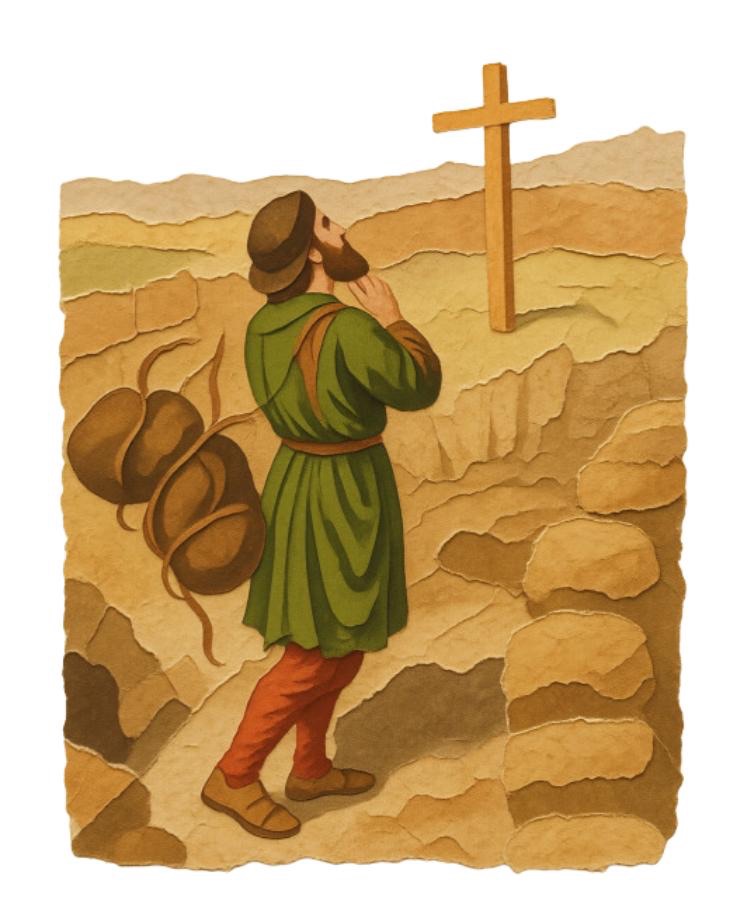
It was the picture of Christian in The Pilgrim’s Progress2 running toward the cross with a heavy burden strapped to his back. And then, as he reaches the cross, the burden suddenly loosens as the straps holding it to his back snap; it falls off and rolls away into the empty tomb at its foot.
I couldn’t shake that image.
Perhaps it was the weight of the season and all it represents. Yet what unsettled me most was this: I realized I could hardly remember what it felt like to carry that burden. Even more, I struggled to fully understand what that burden truly is, especially in light of Jesus’ invitation: “Come to Me, all who labor and are heavy laden, and I will give you rest” (Matthew 11:283).
What burden was He speaking of?
Is it sin itself, or the guilt that clings to it?
Is it the weight of religious striving and expectations?
Or is it something deeper, the condition of a soul separated from God, standing under the weight of His righteous judgment (Romans 3:234; 6:235)?
These are the questions I have been sitting with.
Scripture shows us that many have carried burdens. Consider the Book of Esther. Queen Esther bore the weight of an entire people under threat of destruction (Esther 4:13–166) because Haman had devised a wicked plan to annihilate all the Jews in the land. I’m sure Esther must have felt fear and pressure, but she did not keep this burden to herself. Instead, she sought the One who could give her rest, fasting for three days and bringing the matter before God (Esther 4: 15-16)7.
She understood that to act apart from Him would be futile. So she surrendered the situation to God, and He gave her a strategy.
He responded not only by giving her courage but by working behind the scenes. Even the king’s sleepless night was not without purpose, and rather than turning to wine or entertainment, he was led to the book of Chronicles, where Mordecai was celebrated (Esther 6:18).
When Esther was finally asked what troubled her, she did not rush to present her request but moved with wisdom and patience. In this, we see how God dealt with the burden on her heart and that of all the Jews when she brought it to Him.
In the same way, Iyunade, for the old man to truly become new (2 Corinthians 5:179), we must come to the Lord. We are invited not only to lay down our burdens, but to take up His yoke: “Take My yoke upon you, and learn from Me… For My yoke is easy, and My burden is light” (Matthew 11:29–3010).
There is a divine exchange that takes place.
Likewise, I believe that for the old man to truly become new, we must come to the Lord to gain release from our burdens, whatever they may be. We are to learn from Him and share in His yoke, which is not difficult at all. It is only then that we find rest for our souls.
A soul without burden is one that has allowed Another (Jesus Christ) to carry it, and can now rejoice freely. We begin to see the light, and our backs grow light as well; the burden that once sat heavily on our hearts rolls away and rests in the tomb where Jesus Christ defeated sin.
It begins to make sense, then, why the hymns say:
“Burdens are lifted at Calvary, Jesus is very near” — Burdens Are Lifted at Calvary11
and
“At the cross, at the cross, where I first saw the light,
And the burden of my heart rolled away…” — At the Cross (Alas! and Did My Saviour Bleed)12
These are not merely poetic lines; they are testimonies of what we experience when we come to Calvary. They echo the very reality we see in Christ, in Esther’s surrender, and in the call extended to each of us.
If Jesus was willing to die in our place, then it follows that the burdens we once carried would not remain our own. “Surely He has borne our griefs and carried our sorrows” (Isaiah 53:413). This was the very reason He came, that we might walk in newness of life (Romans 6:414): free, made new, and sealed in Him.
My sincere prayer is that you, too, Iyunade, would find rest for your soul at the feet of the One who bears every burden.
P.s Have you ever heard of the story of Joseph Scriven, who wrote the Famous ‘What a Friend We Have in Jesus’15?
Yours in Jesus Christ,
Adunni
April 20, 2026
- 3 For I handed down to you as of first importance what I also received, that Christ died for our sins according to the Scriptures, 4 and that He was buried, and that He was raised on the third day according to the Scriptures, ↩︎
- YouTube – Video of the burden loosened from Christian’s back (time stamp -48:20) ↩︎
- Come to Me, all who are weary and burdened, and I will give you rest. ↩︎
- for all have sinned and fall short of the glory of God, ↩︎
- For the wages of sin is death, but the gracious gift of God is eternal life in Christ Jesus our Lord ↩︎
- 13Then Mordecai told them to reply to Esther, “Do not imagine that you in the king’s palace can escape any more than all the other Jews. 14 For if you keep silent at this time, liberation and rescue will arise for the Jews from another place, and you and your father’s house will perish. And who knows whether you have not attained royalty for such a time as this?” ↩︎
- 15Then Esther told them to reply to Mordecai, 16 “Go, gather all the Jews who are found in Susa, and fast for me; do not eat or drink for three days, night or day. I and my attendants also will fast in the same way. And then I will go in to the king, which is not in accordance with the law; and if I perish, I perish. ↩︎
- 1During that night the king could not sleep, so he gave an order to bring the book of records, the chronicles, and they were read before the king. ↩︎
- 15Therefore if anyone is in Christ, this person is a new creation; the old things passed away; behold, new things have come ↩︎
- 29 Take My yoke upon you and learn from Me, for I am gentle and humble in heart, and you will find [a]rest for your souls. 30 For My yoke is comfortable, and My burden is light. ↩︎
- Burdens are lifted at Calvary ↩︎
- At the cross (Alas! and Did My Saviour Bleed) ↩︎
- 4However, it was our sicknesses that He Himself bore,
And our pains that He carried; Yet we ourselves assumed that He had been afflicted, Struck down by God, and humiliated. ↩︎ - 4 Therefore we have been buried with Him through baptism into death, so that, just as Christ was raised from the dead through the glory of the Father, so we too may walk in newness of life. ↩︎
- Biography of Joseph Scriven and Lyrics of What a Friend We Have in Jesus ↩︎


Leave a comment